


Purpose
This exercise invites leaders to develop clarity under complexity. Real leadership isn’t tested in calm strategy sessions, but in split-second moral decisions, subtle interpersonal moments and ambiguous dilemmas. This exercise helps delegates rehearse those moments with depth and empathy, preparing them to lead with both head and heart. Through scenarios, delegates learn to enhance their leadership judgment, ethical reasoning and prioritisation under pressure. Particularly when there are high-stakes leadership dilemmas, when time is limited and values are challenged. Ideal for advanced leadership skills.
Objective
In small teams, delegates are presented with short leadership vignettes describing high-pressure or ethically complex moments. For each, they will explore their emotional reaction, identify the core leadership challenge and propose their first three steps. They will explain how their choices reflect both practical action and ethical leadership.
What You Need
- A series of Leadership Vignettes. Have as least as many as third of delegates. Design them based your training needs. Examples are provided at the end.
- Four Analysis Worksheets per team of three. Alternatively, you can project the questions on a screen and let teams to answer them on any blank paper for each round. There are three reflection prompts:
- What is your immediate emotional response?
- What is the core leadership challenge?
- What are your first three steps, and why?
Setup
- Divide delegates into small teams of 2 or 3 people. Each team will receive one vignette at a time.
- You have two options in how you present vignettes:
- Give the same vignettes to all teams and let them analyse it. Then give a new one to all teams and continue for a few rounds.
- Provide a different vignette to each team (or multiple teams). Get them to rotate them around between teams.
- For each vignette (5 minutes):
- Teams read it aloud.
- Identify the immediate emotional response and the leadership challenge in the scenario.
- Agree on three specific actions they would take. How would they justify their choices in terms of ethical reasoning and intended outcomes?
- Write down their analysis so they can share it later.
- Run through 4 vignettes total (or more, if time allows).
- Bring back everyone together and consider a few important vignettes. Get those groups who analysed them to share their insights and the rest of the class to provide feedback and discuss (15 minutes).
- Follow with a discussion.
Timing
Explaining the Exercise: 2 minutes
Activity: (5 min analysis for each vignette x 4 rounds) + 15 min sharing and insights = 35 minutes
Group Feedback: 10 minutes
Discussion
- Which vignettes felt most challenging? Why?
- How did your emotional reactions influence your proposed actions?
- What ethical tensions emerged, and how did you prioritise between values such as transparency vs loyalty, speed vs integrity?
- In what ways can leaders prepare for these moments before they arise in real life?
- How can peer input help leaders see blind spots in decision-making?
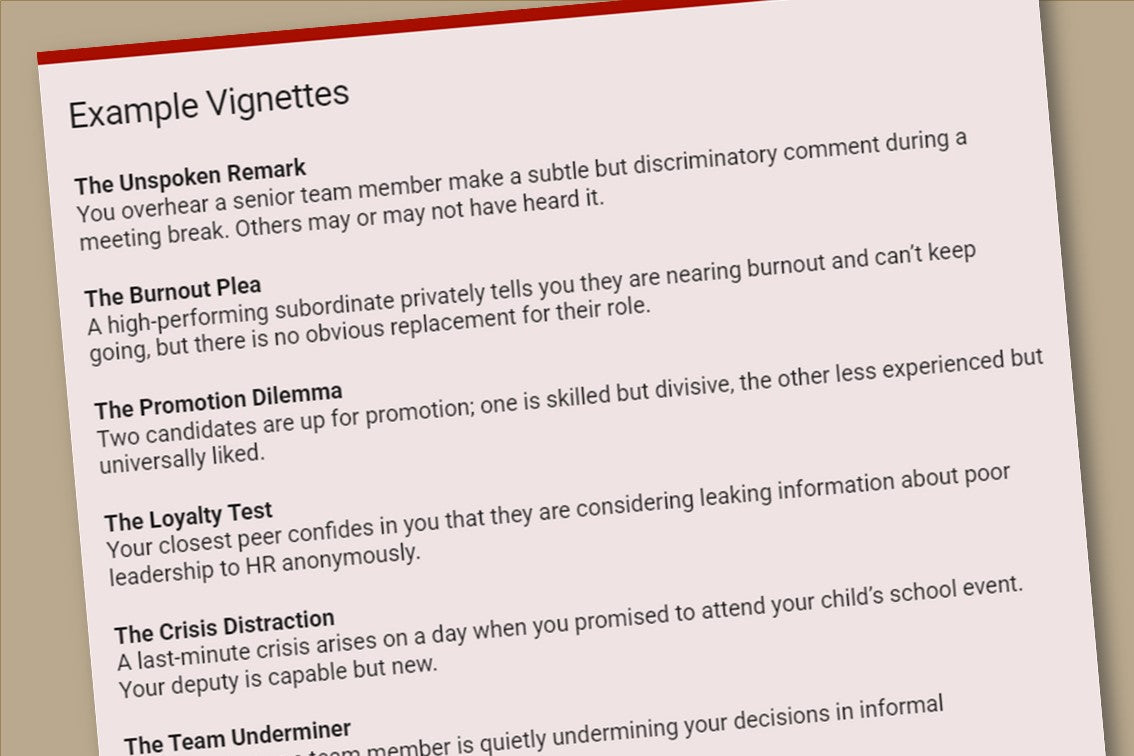
Example Vignettes
The Unspoken Remark
You overhear a senior team member make a subtle but discriminatory comment during a meeting break. Others may or may not have heard it.The Burnout Plea
A high-performing subordinate privately tells you they are nearing burnout and can’t keep going, but there is no obvious replacement for their role.The Promotion Dilemma
Two candidates are up for promotion; one is skilled but divisive, the other less experienced but universally liked.The Loyalty Test
Your closest peer confides in you that they are considering leaking information about poor leadership to HR anonymously.The Crisis Distraction
A last-minute crisis arises on a day when you promised to attend your child’s school event. Your deputy is capable but new.The Team Underminer
You hear that one team member is quietly undermining your decisions in informal conversations.The Ethical Shortcut
Your team suggests a faster solution that would meet the deadline but violates a minor compliance rule.The Cultural Blind Spot
You realise a new policy your team implemented may unintentionally exclude or disadvantage employees from certain cultural backgrounds.The Power Grab
An influential colleague is bypassing you and working directly with your team to influence a project’s direction.The Talent Exit
Your top performer resigns unexpectedly. You sense there is more to the story, but they have chosen not to share why.
Ready-to-Use Soft Skills Training Materials
Editable slides, trainer notes, workbooks and exercises. Download, customise and reuse.
Why Choose Our Training Materials?

Online Train the Trainer Course:
Core Skills
CPD Accredited
Turn Your Expertise into Engaging, Well-Structured Training
Topics
Need a Complete Soft Skills Course to Deliver?
Save preparation time with ready-to-use course packs containing editable slides, detailed trainer notes, participant workbooks and engaging exercises.
Management ◆ Interpersonal Development ◆ Personal Development
The Most Similar Exercises & Articles to This in Order of Similarity Are:





Resources for Trainers and Course Designers
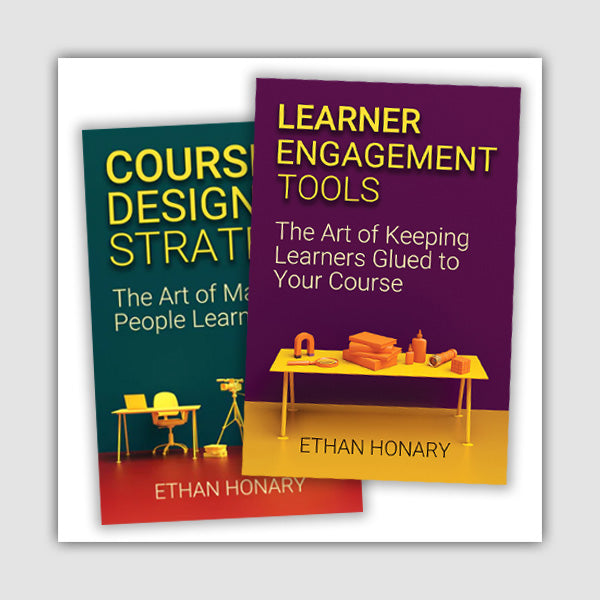
Instructional Design Books
Practical books on course design, learner engagement and training delivery, available in paperback and ebook

Free Training Resources
Download a complete sample course with training activities, assessment forms and practical resources for trainers.

Comprehensive Body Language Guide
Explore body language, gestures, posture, facial expressions and non-verbal communication in one practical guide.

Train the Trainer Resources
Improve course design and delivery with practical guides, specialist books and Train the Trainer courses.
Leave a comment
All comments are moderated before being published.
This site is protected by hCaptcha and the hCaptcha Privacy Policy and Terms of Service apply.