


A while back we sent you a questionnaire with a series of questions on how training courses are conducted. The aim was to develop an insight on how training courses are run across the world and to ultimately see what can be learned from our collective approach to training.
The results of the questionnaire are published below. There was a total of 230 respondents. Although our customers tend to teach soft skills, this is not exclusive and some respondents have considered technical or other courses as well while answering the questions. A question in the questionnaire helps to clarify this.
The results lead to some fascinating insights that require further deliberation. But first, let’s go through main the results of the questionnaire.
How long are your courses?

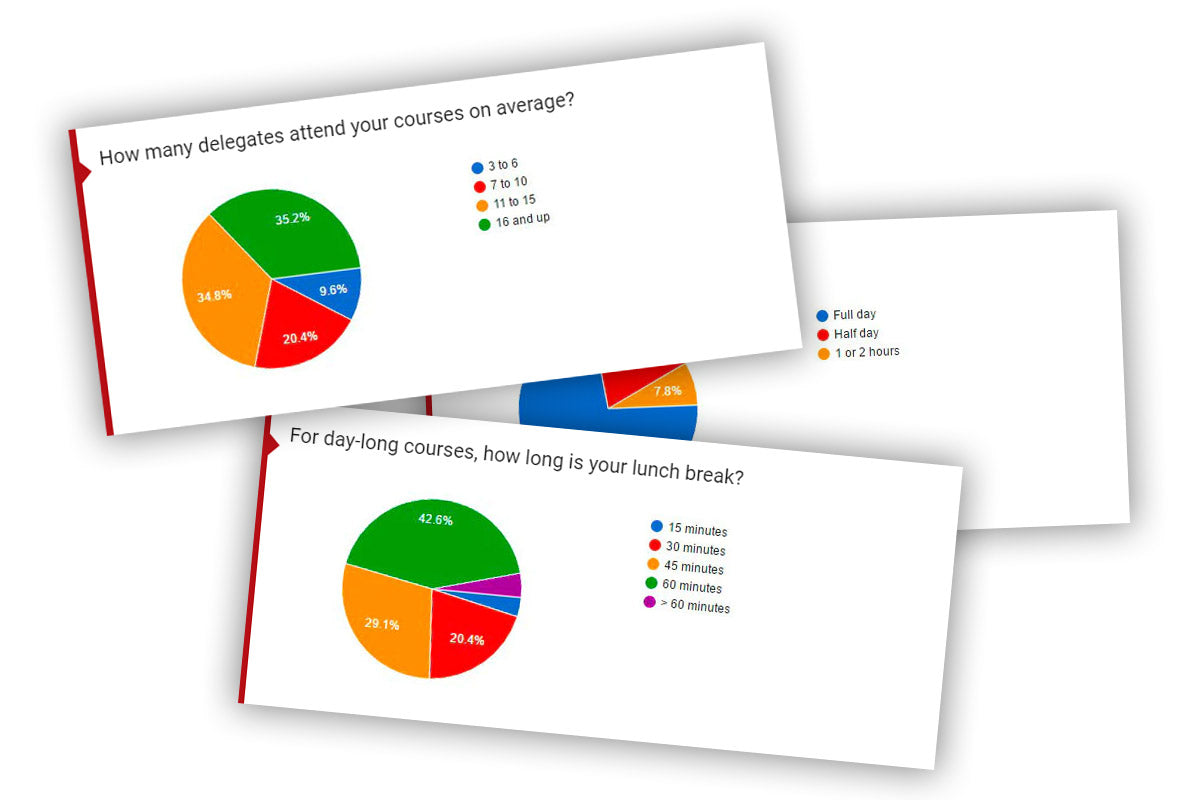
How many delegates attend your courses on average?

For day-long courses, how many breaks do you have other than the lunch break?

For day-long courses, how long is your lunch break?

On average, in your courses, do the delegates know each other or is it the first time they meet?

On average, in your courses, do the delegate belong to the same organisation?

What room configuration do you use while providing training?

What is the average male to female ratio in your courses?

What is your gender?

What is your age?

Are you usually on schedule while going through the delivery of your courses?

Consider the rating you receive from your delegates at the end of the course:

Which one of these areas are your delegates most concerned about?

If you had to rate your training yourself, which area would you say needs most improvement?

How are your delegates on average?

What areas do you usually train people on?

Analysis
Many of these results are self-explanatory and useful. The results that stood out the most were the answers given to the following two questions:
- Which one of these areas are your delegates most concerned about?
- If you had to rate your training yourself, which area would you say needs most improvement?
To be honest, we designed these questions with a specific aim; to see how you view the training you provide and how you think your delegates view it. Set in contrast with each other, we hoped that any discrepancy in results will shed light on the matter. The results are fascinating!
Are Training Materials a Priority?
The answers show the following:
- Trainers think that the area which needs most improvement is their training materials.
- However, they simultaneously believe that the delegates are most concerned about the training delivery.
The question that follows is, if trainers think delegates look for an effective training delivery, why don’t they focus on that, instead of worrying about their training materials?
A possible explanation is that, maybe, trainers think that to deliver a good training course, they need to have good training materials, even though, the training materials are not the priority from the delegates point of view. Delegates won’t go home thinking that the workbook or slides weren’t as good as they hoped. Sure, they may desire better designs, but that is never their main concern; they go home wondering if they learned something useful having spent a whole day in a class with the trainer.
The trainer, on the other hand, values the materials greatly because with a good set of training materials he can focus on improving knowledge transfer and increase long-term retention through meaningful interactive and vivid exercises. Good training materials can even boost a trainer’s confidence in conducting the course and establishing credibility. Armed with this, a trainer hopes to deliver an impeccable training course that ultimately satisfies the delegates’ desire for learning.
Are Slide Design and Workbook Formating a Priority?
Another insight is that trainers should be careful not to get carried away with slide design, workbook formatting, etc. at the expense of improving learning. At the end of the day, delegates want a good training delivery while trainers seem to be more obsessed with their training materials. This could be because it is more fun to spend time fixing fonts, adjusting colours and adding images and charts to slides than to practice improving a live performance or come up with novel exercises that match the learners’ needs.
The questionnaire’s results should be taken as a warning. Your needs and preferences are secondary to that of the learners. Focus on the learners and you will know straight away what needs to be done to improve their learning. Focus on yourself, your own satisfaction of the job or your own bad habits like doing things mindlessly in a certain way because that’s the way it has always been done, and you will be in danger of ending up providing boring training courses—the kind of courses that are forgotten in a day that we all despise.
All in all, we hope that there results of the questionnaire help you see how other trainers conduct their courses. What do you think of the results of the questionnaire? Please share your thoughts below.
Comments

By Hugh D. Snow @ Thursday, November 17, 2016 2:00 AM
As a thirty-plus professor and trainer, I find your training material very rewarding and useful.I'm anxious to see what new aspects of training you introduce. My skills learning students also enjoy the material and the way I present it. Continued success.

By Clarine Powell @ Friday, November 18, 2016 9:45 PM
As a Trainer who is subjected to observations/inspections we have to produce exceptional resources to please our stakeholders. I was once "advised" to use flip chart paper instead of a white board as you can't clean whiteboards properly.

Ready-to-Use Soft Skills Training Materials
Editable slides, trainer notes, workbooks and exercises. Download, customise and reuse.
Why Choose Our Training Materials?

Online Train the Trainer Course:
Core Skills
CPD Accredited
Turn Your Expertise into Engaging, Well-Structured Training
Topics
Need a Complete Soft Skills Course to Deliver?
Save preparation time with ready-to-use course packs containing editable slides, detailed trainer notes, participant workbooks and engaging exercises.
Management ◆ Interpersonal Development ◆ Personal Development
The Most Similar Exercises & Articles to This in Order of Similarity Are:





Resources for Trainers and Course Designers
Instructional Design Books
Practical books on course design, learner engagement and training delivery, available in paperback and ebook

Free Training Resources
Download a complete sample course with training activities, assessment forms and practical resources for trainers.

Comprehensive Body Language Guide
Explore body language, gestures, posture, facial expressions and non-verbal communication in one practical guide.

Train the Trainer Resources
Improve course design and delivery with practical guides, specialist books and Train the Trainer courses.
Leave a comment
All comments are moderated before being published.
This site is protected by hCaptcha and the hCaptcha Privacy Policy and Terms of Service apply.