



Purpose
This is a short, powerful and flexible exercise on storytelling and recall. It shows how critical emotional awareness is in understanding others. It trains delegates to listen actively and attentively without the aid of note-taking. It strengthens memory, focus and the ability to pick up on both factual details and emotional undertones. Use this exercise to prepare delegates for roles that demand clarity, empathy and attention under pressure. It is particularly useful in developing skills for effective communication, coaching, interviewing and client conversations.
Objective
Each delegate listens to a one-minute story shared by a peer and then recalls as many specific details as possible, without taking notes during the story. Details include facts, inferred emotions and tone.
What You Need
- Printed or digital Response Sheets with three sections (example provided at the end). You need as many as you have delegates.
Setup
- Divide delegates into pairs.
- Assign one person in each pair as the storyteller and the other as the listener. They will switch roles later.
- Tell all delegates they may not take notes while listening.
- Instruct the storytellers to prepare a one-minute story. Depending on your training theme, you may ask for a specific type:
- A recent work-related challenge
- A memorable client interaction
- A fictional mini-story
- A personal but light anecdote
- Emphasise that the story should include a mix of facts, emotions, small details and a clear tone.
- Start the storytelling phase (1 minute).
- The storyteller tells their story aloud for exactly one minute. The listener gives their full attention, without interrupting or taking notes.
- Continue to Silent Recall phase (2 minutes).
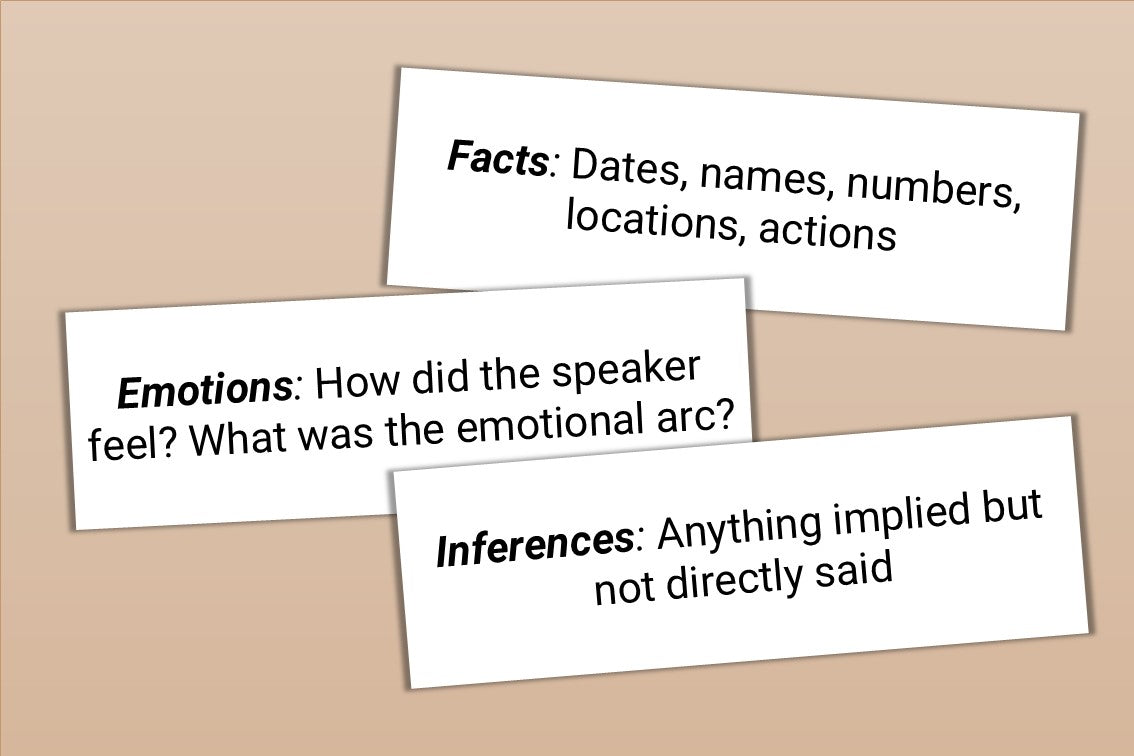
- Immediately after the story ends, ask listeners to fill in their Response Sheet under three headings:
- Facts: Dates, names, numbers, locations, actions
- Emotions: How did the speaker feel? What was the emotional arc?
- Inferences: Anything implied but not directly said
- Lead to the final review phase in the same pairs (3 minutes).
- Ask the listener and the storyteller to read out the notes together. Get them to discuss:
- What did they get right?
- What did they miss or misinterpret?
- Were the emotional cues picked up accurately?
- Switch roles and repeat for the second round.
- Bring back everyone together for group reflection:
- What made it easier or harder to remember the story?
- Did anyone pick up on emotional tone more than facts, or vice versa?
- What surprised you about what was remembered or missed?
Timing
Explaining the Exercise: 5 minutes
Activity: 1 min prep + (6 min storytelling & recall per round x 2 rounds) + 5 min group reflection = 18 minutes
Group Feedback: 10 minutes
Discussion
- Were you more focused on content or emotion while listening?
- What techniques helped you retain information?
- How does this apply to your real-life listening scenarios?
- What do you usually miss in high-pressure conversations, the facts or the feelings?
Response Sheet
Storyteller Name:
Facts: Dates, names, numbers, locations, actions.
Emotions: How did the speaker feel? What was the emotional arc?
Inferences: Anything implied but not directly said.

Soft Skills Training Materials
Get downloadable training materials

Online Train the Trainer Course:
Core Skills
Learn How to Become the Best Trainer in Your Field
All Tags
The Most Similar Exercises & Articles to this in Order of Similarity Are:




Training Resources for You
Course Design Strategy
Available as paperback and ebook

Free Training Resources
Download a free comprehensive training package including training guidelines, soft skills training activities, assessment forms and useful training resources that you can use to enhance your courses.

Our Comprehensive Guide to Body Language

Train the Trainer Resources
Get Insights - Read Guides and Books - Attend Courses
Training Materials
Get downloadable training materials on: Management Training, Personal Development, Interpersonal Development, Human Resources, and Sales & Marketing
Leave a comment
All comments are moderated before being published.
This site is protected by hCaptcha and the hCaptcha Privacy Policy and Terms of Service apply.