


Purpose
This exercise helps delegates explore the concept of temperament, understand what it means, how it is formed and how it can influence their emotional intelligence. Temperament refers to aspects of an individual’s personality that are mainly biological or innate as opposed to learned. Temperament is basically life-long traits that we have acquired early on in life or simply inherited. Here are some examples:
- “I am shy in social settings. I feel uncomfortable if I suddenly find myself at the centre of attention. I guess it comes from my childhood when I was brought up to be a quiet kid.”
- “I was never very sporty or physical when I was growing up so engaging in sports these days doesn’t appeal to me much. Where I grow up, it was frowned upon for girls to do sports.”
- “I like talking. If I enter a room and it is quiet I have the strongest urge to talk and get everyone to listen. I got this from my mom I guess...” [Carries on talking for a while until stopped!]
- “I have always been sporty, even though I was a girl I always liked any sport even if they were predominantly for boys. I guess I got this from my dad who was very athletic.”
In this exercise, delegates explore the nature of their temperament and discuss this with others to better understand what it means.
Objective
Answer the questions provided in the form and then discuss with a partner.
What You Need
- A copy of the “Temperament Questionnaire” for each delegate provided below.
Setup
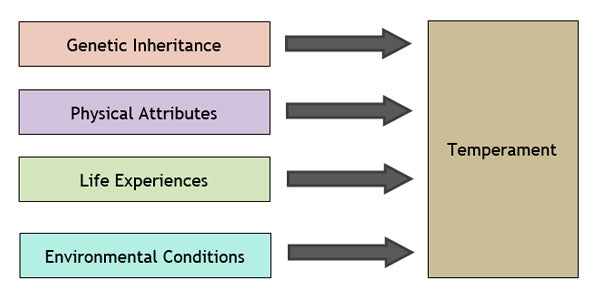
- Explain that temperament is influenced by a mixture of parameters such as the following:
- Genetic Inheritance
- Physical attributes
- Life Experiences
- Environmental Conditions
- Divide the delegates to pairs. If you have an odd number of delegates use a group of 3.
- Distribute a copy of the “Temperament Questionnaire” to each delegate.
- Ask each delegate to answer the questions provided in the form. At this stage, each person works on his own.
- Allocate 15 minutes for this part.
- Ask pairs to share what they recorded on their forms in each group. Each person should take turns to explain what they think of their temperaments. They should also discuss the last question on what they potentially want to change.
- Allocate 15 minutes for this part.
- Bring back everyone together and follow with a discussion.
Timing
Explaining the Exercise: 5 minutes
Activity: 15 min answering questions + 15 min sharing = 30 minutes
Group Feedback: 10 minutes
Discussion
What do you think of the effect of your temperament on your everyday life? How did your partners’ temperament differ from yours? Was it easy to come up with strategies on how to change or modify some of the behaviours discussed?
Temperament Questionnaire
Describe your temperament with three adjectives. Choose the ones that describe you best.
Suggest three adjectives that others use to describe your temperament.
Go through each of the adjectives identified in the above two questions and see if each one is because of Genetic Inheritance, Physical Attributes, Life Experiences or Environmental Conditions.
How do each of the temperamental factors affect you on a personal level?
How do each of the temperamental factors affect you on a leadership role level?
Which of these factors do you want to change and why?
Comments

By Bharti Saini @ Wednesday, January 3, 2018 11:04 AM
Hi,
This one exercise I went thru, does sound interesting...I cant wait to execute in my next training session.
Hope the rest are equally engaging and learning.
Kudos:)
Regards,
Bharti Saini

By Sonal Jaishekhar @ Thursday, February 3, 2022 2:46 AM
I am waiting eagerly for the exercise
Ready-to-Use Soft Skills Training Materials
Editable slides, trainer notes, workbooks and exercises. Download, customise and reuse.
Why Choose Our Training Materials?

Online Train the Trainer Course:
Core Skills
CPD Accredited
Turn Your Expertise into Engaging, Well-Structured Training
Topics
Need a Complete Soft Skills Course to Deliver?
Save preparation time with ready-to-use course packs containing editable slides, detailed trainer notes, participant workbooks and engaging exercises.
Management ◆ Interpersonal Development ◆ Personal Development
The Most Similar Exercises & Articles to This in Order of Similarity Are:





Resources for Trainers and Course Designers
Instructional Design Books
Practical books on course design, learner engagement and training delivery, available in paperback and ebook

Free Training Resources
Download a complete sample course with training activities, assessment forms and practical resources for trainers.

Comprehensive Body Language Guide
Explore body language, gestures, posture, facial expressions and non-verbal communication in one practical guide.

Train the Trainer Resources
Improve course design and delivery with practical guides, specialist books and Train the Trainer courses.
Leave a comment
All comments are moderated before being published.
This site is protected by hCaptcha and the hCaptcha Privacy Policy and Terms of Service apply.