


Purpose
Reciprocal teaching is a technique used by trainers and teachers to facilitate understanding a piece of text. It is designed to promote comprehension by looking at a text from several different angles.
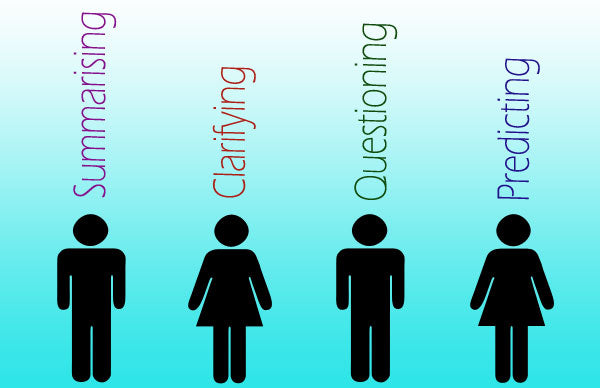
The technique was developed by Palinscar (1986) with an aim to facilitate collaborative investigation. The four comprehension strategies used in this technique are:
- Summarising
- Questioning
- Clarifying
- Predicting
By alternating between these roles, group members can share their analysis with each other systematically while focusing on many aspects of a piece of information or text.
This technique can also be used as a brainstorming technique to prepare for negotiations, making critical decisions and problem solving.
Objective
Based on your specific role, provide inputs to the group so that the group as a whole can understand the subject matter better by viewing it from different angles using the four main comprehension strategies.
What You Need
- Blank cards. You need one per each delegate. On each card write one of the following roles so that you end up with several sets of these roles:
- Summarizer
- Questioner
- Clarifier
- Predictor
- Text, report, story, history or any piece of information to analyse. The text should be in multiple parts so groups can analyse one part at a time. It is up to you to provide the same text to all groups, or give a different text to each group.
Setup
- Divide the delegates to groups of 4. If the number of people are not dividable by 4, use groups of 3 as well and assign multiple roles to some individuals.
- Distribute the target text to everyone.
- Distribute one role card to each person in each group so that each group has all the roles in the set.
- Get each group to read through one part of the target text that you want them to analyse and take notes to prepare for their roles.
- Allocate about 5 minutes for this part depending on the length of text.
- Stop everyone and now ask the Summarisers in each group to deliver a summary about the text to their group members.
- Ask the Questioners to ask questions on:
- Confusing parts
- Unclear parts
- Poor connections to other concepts
- Goals, objectives and motivations
- …
- Ask the Clarifiers to provide a clarification on the questions raised.
- Ask the Predictors to offer suggestions on how the piece will move forward and what happens in the next part.
- Move to the next round by redistributing the role cards so everyone would have a new role.
- Ask the groups to read through the next part while considering their new role.
- Repeat the 4-step comprehension analysis as before and repeat until the text is finished.
- Follow with a discussion.
Timing
Explaining the Exercise: 5 minutes
Activity: 30 minutes
Group Feedback: 5 minutes
Discussion
What did you learn about the text you analysed? How did the multirole analysis help you to comprehend the text better? Which role you found the easiest and which role you found the hardest? Which role was your favourite?
References
Palincsar, A.S. (1986) “Reciprocal teaching. In Teaching reading as thinking”, Oak Brook, IL: North Central Regional Educational Laboratory.
Comments

By lenka @ Tuesday, January 3, 2012 10:12 AM
Exercise seems interesting, I'll try to train "communication" and attach the information as it flourished.
You could also attach a sample version of the text? (I take it I will not translate into Czech, but rather as a demonstration of the dynamics of the text)
Lenka

By Cristian @ Friday, August 23, 2013 12:48 AM
Very nice game. Does anyone have a suggestion for the text?
Ready-to-Use Soft Skills Training Materials
Editable slides, trainer notes, workbooks and exercises. Download, customise and reuse.
Why Choose Our Training Materials?

Online Train the Trainer Course:
Core Skills
CPD Accredited
Turn Your Expertise into Engaging, Well-Structured Training
Topics
Need a Complete Soft Skills Course to Deliver?
Save preparation time with ready-to-use course packs containing editable slides, detailed trainer notes, participant workbooks and engaging exercises.
Management ◆ Interpersonal Development ◆ Personal Development
The Most Similar Exercises & Articles to This in Order of Similarity Are:






Resources for Trainers and Course Designers
Instructional Design Books
Practical books on course design, learner engagement and training delivery, available in paperback and ebook

Free Training Resources
Download a complete sample course with training activities, assessment forms and practical resources for trainers.

Comprehensive Body Language Guide
Explore body language, gestures, posture, facial expressions and non-verbal communication in one practical guide.

Train the Trainer Resources
Improve course design and delivery with practical guides, specialist books and Train the Trainer courses.
Leave a comment
All comments are moderated before being published.
This site is protected by hCaptcha and the hCaptcha Privacy Policy and Terms of Service apply.