


Purpose
This exercise helps delegates learn how to avoid negative mentality in meetings. When confronted with a new idea, most people think of problems first. They first consider how the idea doesn’t work and how it would not be suitable rather than seeing how it can help or have potential if extended or combined with other ideas.
This exercise is a simple technique in helping to avoid this negativity. To take advantage of it however, delegates must consider using the technique back at work when attending meetings.
Objective
While brainstorming or problem solving in a meeting, impose a chosen penalty on anyone who states a negative statement against someone’s idea.
What You Need
- Before the course you need to decide on the penalties as you may require materials for the penalty. Here are some examples. See the setup for details on how to use them.
- A jar to put coins in
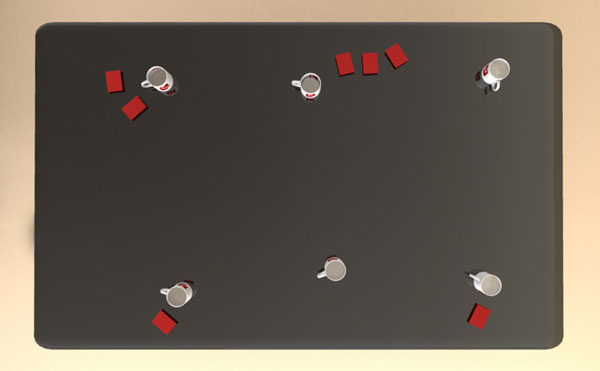
- Red cards to give to people
- A large room which contains space to move chairs around.
Setup
- Ask the delegates to choose a topic to discuss it in a brainstorming session. If they are from the same organisation, it is best if this is related to their work or an on-going project. Otherwise, ask them to choose a topic with a non-obvious answer that can lead to a debate when several solutions are presented.
- Explain that while going through the discussions, ideas should not be killed by negative remarks. Instead, people should help ideas to gain strength rather than spotting their weakness first. As a result, anyone who states something negative is discouraged. Consider the following as examples of how to implement this discouragement:
- Anyone who says something negative should place X amount of coins in a jar. The money would then be used to buy food/snacks for everyone.
- Anyone who says something negative would receive a red card which they place in front of them for all to see. Accumulation of red cards can become embarrassing as it shows a given person is consistently negative. The great benefit with this method is that person finds out for himself that he is indeed more negative than others, which is something that negative people are usually unaware of.
- Anyone who says something negative has to push his chair slightly back (by about half a meter) and so increase his distance with the rest of the group. As more negative statements are stated, the person is automatically isolated by distance.
- Allocate 15 minutes for delegates to go through the discussions while imposing the penalties. Explain that you are the judge of this and your word is final. Be careful not to punish unnecessarily. You aim is to simply point out the obvious problem of killing ideas. Not every “no” is a bad thing as sometimes people disagree simply to clarify what they actually said or meant.
- At the end of the allocated time, bring people’s attention to those who were most negative. Ask them to comment on their own behaviour and especially if they find it surprising that they have been that negative.
- Follow with a discussion.
Timing
Explaining the Exercise: 2 minutes
Activity: 15 minutes
Group Feedback: 5 minutes
Discussion
Were you more negative initially and as you felt the effect of the punishments, became less negative? Did you find it difficult not to say “no” to an idea as soon as you realised it was different form yours? Do you find it difficult not to see the problem first? What did you learn from this exercise? Do you plan to implement this approach back at work? What punishment system would be most effective for the type of work environment you have and the type of meetings you hold?
Ready-to-Use Soft Skills Training Materials
Editable slides, trainer notes, workbooks and exercises. Download, customise and reuse.
Why Choose Our Training Materials?

Online Train the Trainer Course:
Core Skills
CPD Accredited
Turn Your Expertise into Engaging, Well-Structured Training
Topics
Need a Complete Soft Skills Course to Deliver?
Save preparation time with ready-to-use course packs containing editable slides, detailed trainer notes, participant workbooks and engaging exercises.
Management ◆ Interpersonal Development ◆ Personal Development
The Most Similar Exercises & Articles to This in Order of Similarity Are:





Resources for Trainers and Course Designers
Instructional Design Books
Practical books on course design, learner engagement and training delivery, available in paperback and ebook

Free Training Resources
Download a complete sample course with training activities, assessment forms and practical resources for trainers.

Comprehensive Body Language Guide
Explore body language, gestures, posture, facial expressions and non-verbal communication in one practical guide.

Train the Trainer Resources
Improve course design and delivery with practical guides, specialist books and Train the Trainer courses.
Leave a comment
All comments are moderated before being published.
This site is protected by hCaptcha and the hCaptcha Privacy Policy and Terms of Service apply.