


Purpose
Negativity is contagious. It’s all too easy to complain about everything that goes wrong and this can quickly spread to others. Fortunately there is a simple trick that can be used to eliminate negativity; simply don’t say negative words. Aiming for positive remarks helps people to get energised. Rather than looking for blame, seek opportunities to improve and progress forward.
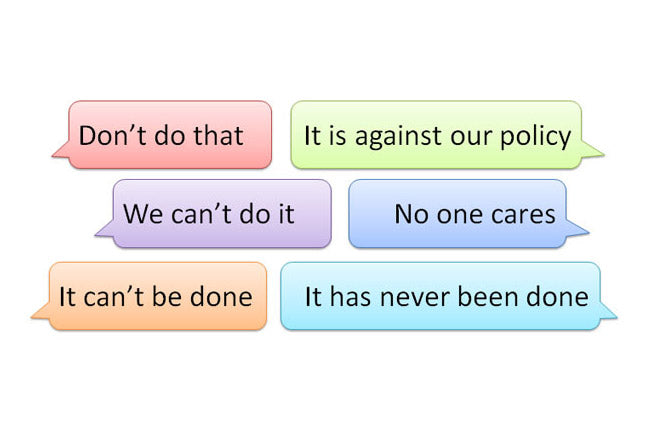
Here are some examples of negative statements that people commonly use:
- Don’t do that
- We can’t do it
- It can’t be done
- We don’t do such thing
- It is against our policy
- We have never done this before
- It has never been done
- No one knows how to do this
- You don’t know how this works
- The management is clueless
- The staff are clueless
- They sit there all day and do nothing
- No one cares
These statements do not help and are sometime stated as a reflex reaction rather than with an appropriate thought. Sometimes they become a habit and it is important to eliminate them as bad habits.
This simple two stage communication skills exercise helps to increase the awareness of delegates about this issue and helps them to address it. It is ideal for delegates who work closely together or are part of the same team so it can also be used as a teambuilding activity at work.
Objective
Identify negative statements used at work and formulate positive replacement statements for them.
What You Need
- Papers or small notebooks
Setup
- You have the option to carry out this exercise over two stages at different times (Option 1), or carry out both stages in one session (Option 2):
Option 1:
-
Stage 1:
- Ask delegates to monitor each other during a typical day at work and take note of every negative statement they hear or read as part of communicating with other team members. They should also include all the negative statements they say themselves.
- It is important to record only the negative statements, not who said it. If the statement makes it clear who has said it, they should make it anonymous. This exercise is not about blaming or telling people off. It is only about becoming aware of negative statements that we all say and taking steps to turn them into positive statements.
- Ask delegates to write these negative statements on paper or a notebook and bring them to the training class for stage 2.
-
Stage 2:
- Divide the delegates into groups of 2 or 3.
- Ask each group to share the negative statements they have heard with each other.
- Each group should compile a set of negative statements that are most frequently heard from their sets.
- Each group should then think of positive statements that can be used to replace these negative statements. These should be recorded as well so they can share it with the class later.
- Allocate 15 minutes for this part.
- Bring back everyone together and ask each group to share their negative statements.
- Ask delegates to suggest these statements. As they suggest them record a summary of the most common negative statements on a flipchart or a whiteboard.
- Ask the delegates to discuss the replacement positive statements for each based on their earlier analysis. Record these statements on the flipchart as well.
- Encourage a discussion on how negative statements can be destructive and how important it is to replace them.
Option 2:
-
Stage 1:
- In this option, this stage takes place in a training room at the same time as stage 2.
- Divide the delegates into groups of 2 or 3.
- The difference in this option is that rather than observing and taking notes on a separate day, groups compile a set of commonly used negative statements that they have heard in the past and compile a list.
- Ask them to record these statements on a paper.
- Allocate 10 minutes for this part.
-
Stage 2:
- This is similar to stage 2 described for option 1 above as groups should analyse the statements and compile a replacement set of positive statements.
Continue with the instructions for stage 2 presented above.
Timing
Explaining the Exercise: 5 minutes
Activity:
- Option 1: 15 min stage 2 analysis + 10 min sharing = 25 minutes
- Option 2: 10 min stage 1 + 15 min stage 2 analysis + 10 min sharing = 35 minutes
Group Feedback: 10 minutes
Discussion
Are you susceptible to use negative statements? How frequently are they used in your organisation? Are they necessary? Can they be avoided? How can you avoid them? Is it easy to replace them with positive statements? Was there a consistent set of negative statements between groups that suggests many people hear all the time at their workplace? What are you planning to do to eliminate them?
Comments

By Rehana @ Tuesday, January 31, 2012 12:28 PM
Training topic and theme is too good, beacuse i personally seen majority of people around us are negative. i hope this activity would enabled many of us to identify and rectify our negative thinking and conversation.

By Ehsan Honary @ Thursday, February 2, 2012 10:55 AM
Rehana, you are absolutely right. This is something that can easily change the atmosphere of a workplace and bring the whole team down. People tend to see problems more than the things that actually work and hence become negative. So aiming for a balanced view is always critical, and this requires training and persistence. A happy workforce is much more productive and satisfied.

Soft Skills Training Materials
Get downloadable training materials

Online Train the Trainer Course:
Core Skills
Learn How to Become the Best Trainer in Your Field
All Tags
The Most Similar Exercises & Articles to this in Order of Similarity Are:



Training Resources for You

Course Design Strategy
Available as paperback and ebook

Free Training Resources
Download a free comprehensive training package including training guidelines, soft skills training activities, assessment forms and useful training resources that you can use to enhance your courses.

Our Comprehensive Guide to Body Language

Train the Trainer Resources
Get Insights - Read Guides and Books - Attend Courses
Training Materials
Get downloadable training materials on: Management Training, Personal Development, Interpersonal Development, Human Resources, and Sales & Marketing
Leave a comment
All comments are moderated before being published.
This site is protected by reCAPTCHA and the Google Privacy Policy and Terms of Service apply.