



Deadlines are a fact of modern life and professionals in just about any role need to be able to efficiently deal with them. However, people deal with deadlines in different ways based on their personality. Deadlines can be stressful and the way people deal with this stress usually comes to define their success and subsequently the success of the team, especially when things go wrong. This article shows why everyone, team members or managers, must be aware of these differences and make decisions based on this knowledge.
What Is the Difference Between Planners and Spontaneous People
Many research studies show that people can be divided into two types; the Planners or the Spontaneous. The planners like to make lists, know what they need to do in a specific order and will feel lost if they don’t have a good plan. The Spontaneous like the thrill of the moment or the pressure and excitement of the work and are usually quick to start something and slow to finish it off. As with any behavioural trait, each quality can be detected in everyone, though some prefer one type over the other.
Both types can be found in a team and in fact research shows that it is better to have both types present as their existence makes the team much more balanced and efficient. However, when it comes to deadlines, differences start to get in the way and a good manager should be completely aware of these preferences and act accordingly.
The best way to explain these differences is with an example. Suppose Albert is a Planner. He likes to know what happens in each step and usually likes to have a full view all the way to the deadline. It is likely for Albert to get stressed earlier rather than later. Since he is a planner, Albert can quickly see he is falling behind the schedule and may get stressed as a result. He is likely to put a lot of hours to get back on the schedule so he can have a comfortable finish all the way to the end. He simply hates rushing things and usually believes those who rush before deadlines are those who didn’t plan well. Back in his university days, Albert was a student who studied well in advance and simply put everything aside the day before the exam. He was prepared; there was simply no point to study anymore.
Now consider Jane who is Spontaneous. She likes the thrill and excitement of being under pressure. Somehow this gives her a focus that she does not get any other way. The pressure makes her work harder and she thinks this is the way to get the best out of her. She dreads planning, can’t be bothered despite being told to do so and thinks planners are way too rigid and inflexible. She likes to leave everything to the end and then finish it all off with one large burst of activity even with no sleep for a couple of days. She then enjoys telling everyone how hard she worked for this. Back in university, she always left the revision to the last few days before exam. She went to overdrive and studied all the way to the last minute. It was common to see her going through her notes even 10 minutes before the exam.
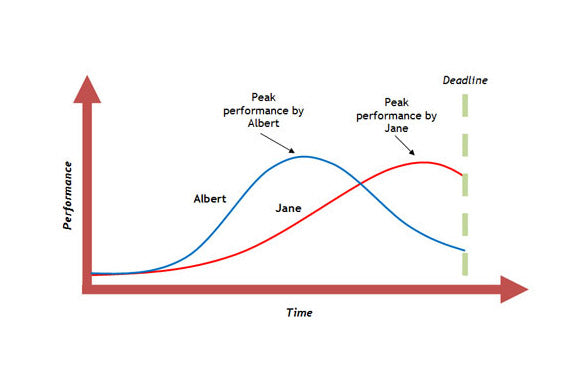
Now imagine if Jane was Albert’s manager. Albert will plan everything to the end. He will naturally peak well before the deadline because that’s the way he works. He prefers to have the stress sooner than later. On the other hand, Jane is still relaxed and doesn’t see the necessity to worry about the deadline. Eventually a few days before the deadline, Jane starts to feel the pressure and decides to make sure all is well. This is when Jane starts to look deeper into the project, introduces lots of change, initiates product modifications, feature additions and etc. since she is in overdrive and is coming up with lots of new cool ideas (at least in her own view). On the other hand, Albert is frustrated by all of these requests. He worked hard to avoid the last minute stress and now he is getting exactly what he dreaded. Worst, it is not his fault, it is his manager’s. If he declines to implement the new changes, his manager will not be pleased. He thinks he doesn’t deserve this.
If you draw their performance graph before the deadline, it will look like the curves shown in the illustration. Albert simply peaks sooner than Jane and Jane can frustrate Albert by giving him lots of work at the time when he is not as efficient as he can be.
How to Make People Reach Their Peak Performance
A good manager must be aware of this phenomenon and take steps to adjust so that team members operate at their peak performance. One way is to artificially adjust the deadlines so that everyone is peaked at the right time. For example, you can give earlier deadlines to those team members who peak later, so you can bring their peak performance forward and line it up with those who have an early peak.
In any case, as you can see, you should be aware that people have different styles of work and that treating everyone the same is suboptimal for the group as a whole. Rather than pushing team members to conform to a specific style, you will much better off to take advantage of their natural strength and peak performance at the right time. As a manager, you can achieve this by engineering their environment, restructuring their schedule, controlling their interaction and optimising their workflow.

Soft Skills Training Materials
Get downloadable training materials

Online Train the Trainer Course:
Core Skills
Learn How to Become the Best Trainer in Your Field
All Tags
The Most Similar Exercises & Articles to this in Order of Similarity Are:






Training Resources for You

Course Design Strategy
Available as paperback and ebook

Free Training Resources
Download a free comprehensive training package including training guidelines, soft skills training activities, assessment forms and useful training resources that you can use to enhance your courses.

Our Comprehensive Guide to Body Language

Train the Trainer Resources
Get Insights - Read Guides and Books - Attend Courses
Training Materials
Get downloadable training materials on: Management Training, Personal Development, Interpersonal Development, Human Resources, and Sales & Marketing
Leave a comment
All comments are moderated before being published.
This site is protected by reCAPTCHA and the Google Privacy Policy and Terms of Service apply.