

Purpose
This is an ideal exercise which enables participants to find out more about themselves. It is highly effective in bringing up lots of hidden issues that could be present in the team and causes conflicts. This self-probation can be used for coaching where team members can clearly see various points of view and based on those take steps to move the team forward towards its ideal state. This is effectively a self-coaching exercise where only the team members’ views are used to evaluate the group. This activity is as opposed to using 360 degree questionnaires or other elaborate formal feedback mechanisms used in some organisations. Indeed, since team members know more about their own team more than anyone else, their self-analysis will be more useful and accurate than many other methods.
Objective
Delegates identify a number of qualities for the team and then score themselves for these qualities.
What You Need
- Papers
- Pens
Setup
- Ask the delegates to identify 4 critical qualities of a team. Ask them to write these on paper so their choices are made independence of each other.
- Collect all the papers.
- For example, the following might be suggested:
Julia
Charles
Sally
Chris
Friendship
Trust
Compatibility
Enthusiasm
Cooperation
Support
Trust
Boldness
Innovative
Flexibility
Tolerance
Vision
Humour
Vision
Finisher
Patience
- Merge all the qualities and compile a long list. You may write this on a flipchart, a whiteboard or type it into a spreadsheet which is projected on the wall to prepare for the next step.
- Ask the delegates to score their teams based on these qualities from 1 to 10 with 10 being the best. Ask them to write these on paper, so their votes are made independent of each other.
- Collect their scores and compile a new table based on the scores given by the team and then calculate the average score for each quality (the spreadsheet will be handy for this).
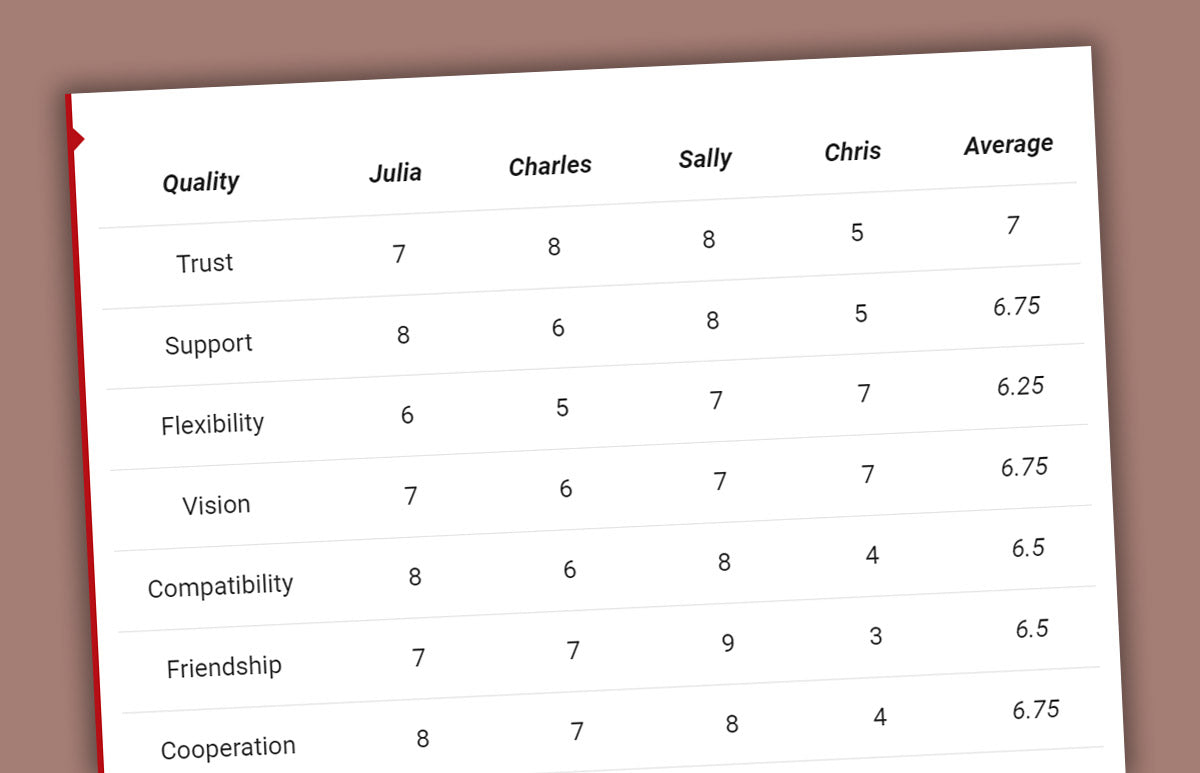
- The table may look like the following:
Quality
Julia
Charles
Sally
Chris
Average
Trust
7
8
8
5
7
Support
8
6
8
5
6.75
Flexibility
6
5
7
7
6.25
Vision
7
6
7
7
6.75
Compatibility
8
6
8
4
6.5
Friendship
7
7
9
3
6.5
Cooperation
8
7
8
4
6.75
Innovative
4
7
8
8
6.75
Humour
8
6
7
4
6.25
Tolerance
9
6
8
8
7.75
Finisher
5
7
7
7
6.5
Enthusiasm
7
7
6
6
6.5
Boldness
5
6
7
7
6.25
Patience
5
7
6
5
5.75
- Show or distribute the final table to all delegates and follow with a discussion.
Timing
Explaining the Test: 5 minutes.
Activity: 20 minutes
Group Feedback: 15 minutes.
Discussion
What does this table show? What can you learn from it?
The table opens us many discussions automatically and is quite revealing. For example, Julia and Sally seem to find the team a happy fun place where they feel reasonably satisfied. On the other hand, Chris and Charles don’t seem to fit in and probably feel left out (why is that?). The highest rating is given to tolerance, which is probably why the team is still functioning together despite the differences in fitting in (why the team is so tolerant?). The team members have given the lowest score to patience, so this is something the group has to think about and explore to find the root causes of it.
This exercise and its potential variations are incredibly powerful for coaching, self-coaching and team building to quickly find out what the team thinks of itself. Since the team knows more than other people about itself, this exercise can be quite educational and realistic.
Variations
You can apply this not just to the team, but to the whole organisation. If you are worried that the staff will not give their honest opinions, collect anonymous scores and then use the average scores as the final results to evaluate the collective feeling of the company towards itself.

Soft Skills Training Materials
Get downloadable training materials

Online Train the Trainer Course:
Core Skills
Learn How to Become the Best Trainer in Your Field
All Tags
The Most Similar Exercises & Articles to this in Order of Similarity Are:






Training Resources for You
Course Design Strategy
Available as paperback and ebook

Free Training Resources
Download a free comprehensive training package including training guidelines, soft skills training activities, assessment forms and useful training resources that you can use to enhance your courses.

Our Comprehensive Guide to Body Language

Train the Trainer Resources
Get Insights - Read Guides and Books - Attend Courses
Training Materials
Get downloadable training materials on: Management Training, Personal Development, Interpersonal Development, Human Resources, and Sales & Marketing
Leave a comment
All comments are moderated before being published.
This site is protected by reCAPTCHA and the Google Privacy Policy and Terms of Service apply.